By Peter Hartlaub, Culture CriticJune 18, 2026 - San Francisco Chronicle
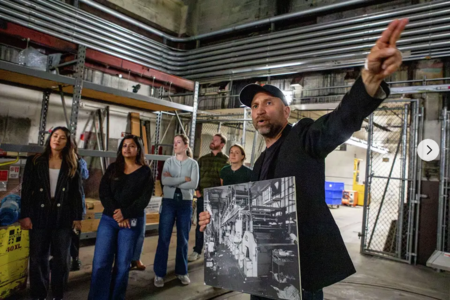
When I took my first steps inside the San Francisco Chronicle building at 901 Mission St., as an elementary school student around 1980, it felt like a ride at Disneyland.
“Everyone quiet, do you feel that?” a tour guide said as we stood in the third-floor lobby just outside the elevators.
The marble floor beneath us rumbled. A massive steel printing press, lurking four stories below in a sub-basement like a sleeping dragon, had just started running again.
I became a Chronicle paperboy in 1983, then a reporter in 2000. I’ve spent more than half my life as an employee of this magical newsroom at Fifth and Mission streets. And the building still feels like a living thing.
But late Thursday afternoon, for the first time in 102 years, news production ended at 901 Mission. The Chronicle is moving to a high-rise at 450 Sansome St. in the Financial District for at least six years, maybe forever, while a structure adjoining the 901 Mission St. newsroom is demolished and a condo project rises in its place.
The Chronicle is leaving its home of 102 years. It’s not the tragedy I expected
Greg
Quick and Dirty
When I took my first steps inside the San Francisco Chronicle building at 901 Mission St., as an elementary school student around 1980, it felt like a ride at Disneyland.
“Everyone quiet, do you feel that?” a tour guide said as we stood in the third-floor lobby just outside the elevators.
A new radio tower for television station KRON on top of the Chronicle building in 1947.
Ken McLaughlin/S.F. Chronicle
The marble floor beneath us rumbled. A massive steel printing press, lurking four stories below in a sub-basement like a sleeping dragon, had just started running again.
Advertisement
Article continues below this ad
I became a Chronicle paperboy in 1983, then a reporter in 2000. I’ve spent more than half my life as an employee of this magical newsroom at Fifth and Mission streets. And the building still feels like a living thing.
But late Thursday afternoon, for the first time in 102 years, news production ended at 901 Mission. The Chronicle is moving to a high-rise at 450 Sansome St. in the Financial District for at least six years, maybe forever, while a structure adjoining the 901 Mission St. newsroom is demolished and a condo project rises in its place.
The San Francisco Chronicle’s 1924 printing press makes a test run in the basement of the newsroom’s new 901 Mission St. offices.
Gabriel Moulin/Moulin Studios
I’ve written dozens of eulogies for other local entities. An iconic seaside restaurant closes. Museums find new homes. A sports team moves to Santa Clara. A beloved alligator dies. Each one felt personal, yet distant. How would it feel, I thought as the news broke last year, when the obituary is for my professional home?
See more S.F. Chronicle on Google
Make us a Preferred Source to get more of our news when you search.
Add Preferred Source
The answer surprised me, and it reinforced what the Chronicle has taught me about change in San Francisco.
Advertisement
Article continues below this ad
The Chronicle’s move to the corner of Fifth and Mission streets in 1924 was a surprise as well. The newspaper was founded in 1865, with a borrowed $20 gold piece, by teenagers Charles and Michael de Young, who located their first three newsrooms in the center of downtown. (Charles was shot to death in the lobby in 1880 by the mayor’s son.) The third newsroom, built at the corner of Kearny and Market streets in 1890, had bragging rights as the tallest building in San Francisco.
It prospered as an act of hubris but failed as a newsroom. The reporters, copy editors and art department were all on different floors. The presses were across town. When the 1906 earthquake struck, the Chronicle’s Market Street headquarters was gutted by fire, and the newspaper had to be printed in Oakland.
The Chronicle city room on June 1, 1987.
John O'Hara/S.F. Chronicle
Surviving brother Michael de Young, 75 years old in 1924, took notes. The U.S. Mint on Fifth Street had been virtually untouched by the earthquake and fire. The publisher bought the block across the street to create “the most modern newspaper production plant in the world.”
De Young heralded his gleaming “news factory” in a Chronicle special section published on Nov. 13, 1924. Behind its Gothic exterior were steampunk guts, including conveyor belts to carry metal plates for printing, pneumatic tubes to whisk messages through walls and across floors, and a wide-open main hall “filled by men and women hammering away for dear life on their typewriters.”
Each floor had a full acre of space. From the writers to the designers to the typesetters, nobody had to travel more than 30 feet for their leg of the news production relay. The press was in a sub-basement with massive elevators that moved pallets of newspapers to a Minna Street alley, where trucks waited to distribute the papers to all corners of the city.
The Chronicle newsroom at 901 Mission St. in the 1940s.
S.F. Chronicle
“This is no grim and gloomy factory of the old style,” one unnamed Chronicle reporter was quoted as saying, “but a building alive, in a pleasant mood, aspiring, and with strength and energy to realize its aspirations.”
Michael de Young, who died three months after the doors opened, traded ego for pragmatism. His decisions proved insightful. The Chronicle has been the only major metropolitan newspaper to stand in its current headquarters for more than a century.
But times change and ignore those clinging to the past. The printing press was removed in the early 1990s, while I was still in college. (We print in Fremont now.) The composing room, where crews cut and pasted pages with X-Acto knives, gave way to computerized layout. Darkrooms disappeared in the age of digital photography. Our night shift mostly works remotely now. In recent years, page design was moved to Houston.
The pandemic in 2020 revealed how much had changed. The newsroom was abandoned except for our editor in chief and an assistant to handle the mail, and yet the finished product looked the same, revealing that our news factory had become a mirage. Once a young reporter here, I was now the veteran, telling tired stories of waiting at the nearby M&M bar for my articles to get edited. The sleeping dragon of a printing press feels like a myth.
“Are you OK?” was the chorus I heard when the news of our move broke last year. My much younger colleagues, who were excited about the departure from our current location (surrounded by dead malls and rats climbing through Mint Plaza) to a neighborhood with a more thriving bar scene and wild parrots, refrained from celebrating near me.
Surprising myself, I was very much OK.
My job digging through the Chronicle archive — which includes old typewriters, rotary telephones and other artifacts of 901 Mission — brought me even closer to the building. But it also conditioned me to accept the reality of change in the city.
The view from the Chronicle clock tower in November 1924.
Gabriel Moulin/Moulin Studios
Was the closure of Westfield mall really an existential threat for downtown, or a natural cycle of change on Market Street which in previous lives hosted a 15,000-seat ballpark, a thriving cinema district and the only place to meet the real Santa Claus? Did we lose an icon when Candlestick Park met the wrecking ball or gain the sporting arena San Francisco deserved in the first place?
I’ve seen so many beleaguered media institutions move their newsrooms from stately buildings to cheaper land, or disappear altogether, or both. (RIP Oakland Tribune.) Our move feels more lateral, like eating at Tadich Grill one night and Mister Jiu’s the next.
Maybe the tears will come when I arrive to an empty newsroom. (Our archive will stay at 901 Mission, and I’ll visit often.) But I don’t think so. If there’s one thing digging through history has taught me, it’s that our city thrives because of its frequent reinventions, not in spite of them.
These are the two truths of San Francisco: The city was uniquely built for reinvention. And there never was a golden age. My Chronicle colleagues of the past knew this. They predicted that this building would serve San Francisco. And they predicted journalists would outlast these walls.
“Will we ever move again?” the unnamed reporter finished on the day of the building’s 1924 debut. “Well if we do, I know it will be because the Chronicle will once more be a prophet of the San Francisco of Tomorrow.”