Probably not a great weekend to drive to Big Sur.
Highway 1 is open again. Big Sur is having a very big comeback
By Connor Letourneau, Staff Writer June 29, 2026
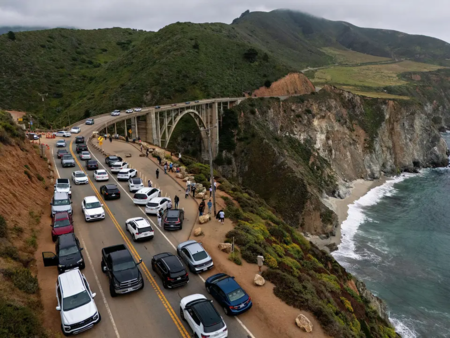
Bixby Bridge in Big Sur has become such a popular stop for photos that Monterey County last week passed a yearlong ban on parking nearby.
BIG SUR — For three years, while major road closures devastated tourism along this iconic stretch of Highway 1, Adirondack chairs often sat eerily empty in the shallow river behind Big Sur’s oldest resort.
But on a breezy Thursday morning in mid-June, the chairs were nearly full with about a dozen lounging guests. One honeymooning couple posed for selfies as the cool water rushed over their bare feet.
“It’s not even the weekend yet, so this is nice to see,” said Colin Twohig, the Big Sur River Inn’s general manager, between puffs of his cigarette. “After dealing with disruptions for so long, we feel optimistic about the future.”
Perched between the Santa Lucia Mountains and the Pacific Ocean, with dramatic cliffs, loose soil and increasingly harsh weather, Big Sur lies along a 75-mile ribbon of Highway 1 that one prominent geologist recently called the most “environmentally fragile piece of roadway in the entire country.” For the last decade, the roughly 1,200 year-round residents of this remote span of coastline haven’t gone a year without some disaster — a rockslide, a wildfire, a mudslide — causing a significant road closure that deterred tourism.
https://www.sfchronicle.com/california/article/big-sur-tourism-22307893.php
Greg
Quick and Dirty
BIG SUR — For three years, while major road closures devastated tourism along this iconic stretch of Highway 1, Adirondack chairs often sat eerily empty in the shallow river behind Big Sur’s oldest resort.
But on a breezy Thursday morning in mid-June, the chairs were nearly full with about a dozen lounging guests. One honeymooning couple posed for selfies as the cool water rushed over their bare feet.
“It’s not even the weekend yet, so this is nice to see,” said Colin Twohig, the Big Sur River Inn’s general manager, between puffs of his cigarette. “After dealing with disruptions for so long, we feel optimistic about the future.”
Perched between the Santa Lucia Mountains and the Pacific Ocean, with dramatic cliffs, loose soil and increasingly harsh weather, Big Sur lies along a 75-mile ribbon of Highway 1 that one prominent geologist recently called the most “environmentally fragile piece of roadway in the entire country.” For the last decade, the roughly 1,200 year-round residents of this remote span of coastline haven’t gone a year without some disaster — a rockslide, a wildfire, a mudslide — causing a significant road closure that deterred tourism.
Advertisement
Article continues below this ad
Tourists crowd for photos of the famous Julia Pfeiffer Burns waterfall in Big Sur. For the first summer in three years, Highway 1 through Big Sur is fully open, resulting in a boom in tourism and some headaches for locals.
Kodiak Greenwood/For the S.F. Chronicle
The latest shutdown was the longest since Highway 1 was completed in 1937. By the time the route to the south reopened this past January, back-to-back landslides had cut off the area’s only road in or out for exactly three years.
Local businesses that persisted are now being rewarded. On the Sunday before Memorial Day, just four months after Highway 1 fully reopened, the River Inn clocked more than 1,200 visitors at its restaurant alone.
See more S.F. Chronicle on Google
Make us a Preferred Source to get more of our news when you search.
Add Preferred Source
“That might be the best day we’ve had in our entire 92-year history,” said Twohig, a 36-year-old Monterey County native with a thick red beard and gold earring. “And we’re not alone. Business is good everywhere.”
Advertisement
Article continues below this ad
 Monterey
MILES
Carmel
Salinas River
Carmel Valley
Big Sur River Inn
Rocky Creek slide,
2024
Nepenthe
Big
Sur
Henry Miller
Memorial Library
King
City
Pfeiffer Canyon Bridge,
2017
Deetjen’s Big Sur Inn
Pacific Ocean
JOLON RD.
Pfeiffer Big Sur State Park
Rat Creek slide, 2021
Dolan slide, 2024
Limekiln
State Park
Regent slide, 2024
Lucia
NACIMIENTO-
FERGUSSON RD.
Paul’s slide, 2024
Jolon
Mill Creek slide, 2023
Fort Hunter
Liggett
Gorda
Mud Creek slide, 2017
Ragged Point Inn
S.F.
Ragged Point
Polar Star slide, 2023
Detail
Los Angeles
San
Simeon
Map: John Blanchard/S.F. Chronicle • Sources: OpenStreetMaps, OpenTopography, CalTrans, USGS
Since visitors started driving Big Sur’s entire coastline again 5½ months ago, local restaurants and shops have seen a 40% surge in visits, according to Caltrans. Weekend business is nearly double last year’s levels, and many hotels report full bookings on especially busy holidays more than six months in advance.
According to Visit California, northbound traffic at Ragged Point, a viewpoint just south of the long-shuttered portion of Highway 1, has spiked more than 900% from a year earlier. Some businesses in that area have twice as many guests.
“The pent-up demand was just unreal,” said Kirk Gafill, president of the Big Sur Chamber of Commerce and manager of fabled cliffside restaurant Nepenthe. “As soon as the road reopened, a flip switched, and tourist season was on.”
On that recent Thursday, guests waiting for seats along Nepenthe’s terrace couldn’t see the restaurant’s famous ocean view through all the fog. Still, about a half hour before it opened for lunch, its parking lot was already filling up.
Colin Twohig, general manager of the Big Sur River Inn, says the hotel and restaurant business is booming. Since visitors started driving Big Sur’s entire coastline again 5½ months ago, local restaurants and shops have seen a 40% surge in visits, according to Caltrans.
Kodiak Greenwood/For the S.F. Chronicle
Gafill, Twohig and other Big Sur diehards have long embraced the trade-off of life at the edge of the continent: To live amid stunning natural beauty, you must endure the relative isolation and volatile landscape, where even booming business can bring frustrations.
Twohig has spent months scrambling to add employees, only for a region-wide labor shortage to leave the River Inn short-staffed. On sunny weekends, Highway 1 has been flooded with selfie-seeking tourists stopping traffic for the perfect shot and blocking scenic pullouts. To ease congestion at Big Sur’s most Instagrammable landmark, Monterey County supervisors last week passed a one-year ban on parking near Bixby Bridge.
Big Sur River Inn, known for its Adirondack river chairs, is doing a brisk business after struggling through lengthy road closures.
Kodiak Greenwood/For the S.F. Chronicle
Through it all, small-business owners have tried to strike a delicate balance, reveling in some hard-fought gains while remaining pragmatic. Rather than overhauling their strategy to increase their profits, they hope to keep things simple and pad their financial reserves.
“It’s all about adopting a conservationist mindset,” said Matt Glazer, executive director of the historic Deetjen’s Big Sur Inn, where guests can unplug in front of wood-burning stoves or candlelit dinners of seafood paella and slow-braised beef ragu. “You have to always make sure you’re preparing for the rough times.”
Matt Glazer, executive director of the historic Deetjen’s Big Sur Inn, said business owners in the area need to be prepared for difficult stretches.
Kodiak Greenwood/For the S.F. Chronicle
A changing climate of stronger storms, higher waves and fiercer wildfires only adds to the urgency. UC Santa Cruz professor Gary Griggs, who has studied Big Sur’s fragile geology for more than 50 years, sees life getting even tougher for small businesses here.
With considerable precipitation expected this winter, he foresees more frequent mudslides and rockslides. Big Sur’s wide-ranging geological formations are loaded with gaps and joints. During heavy rains, water seeps into those cracks, mixes with finely crushed rock and creates a smooth mush prone to trigger landslides.
“Just when you might think things are improving on that part of Highway 1,” Griggs said, “another rockslide comes and reminds you: Everything there is just a Band-Aid.”
Not that locals need reminding after the past decade. Starting in 2016, they’ve dealt with a forest fire that destroyed more than 50 homes, a massive mudslide that stranded residents for eight months, and a slew of smaller landslides that disrupted tourism.
In January 2023, just as small businesses were rebounding from a COVID-era slump, back-to-back landslides severed traffic from the south of Big Sur. For three years, more centrally located businesses like the River Inn and Deetjen’s reported losing at least 30% of their typical revenue. Those figures were far worse for mom-and-pop shops in the most isolated pockets of Big Sur’s southern coast.
The Ragged Point Inn, which sits on a cliff-top bluff about 350 feet above the Pacific and 15 miles north of Hearst Castle, is so remote that its employees occasionally subsist on airdropped groceries during road closures. When those successive landslides wiped out most of the resort’s usual business in 2023 and 2024, it took out loans, redid its website, organized summer concerts — anything to entice people to drive up hours from Southern California.
“We’ve been open since 1962 and, for a while during the latest batch of closures, we were really worried it was all coming to an end,” said Diane Ramey, whose family owns the Ragged Point Inn.
Looking north along Highway 1, where a slide occurred March 30, 2024, isolating tourists and residents. The road fully reopened in January 2026.
Kodiak Greenwood/For the S.F. Chronicle
The Highway 1 repair work was so precarious in places that, to keep road crews safe, Caltrans deployed remote-operated bulldozers and excavators. In the process, it encountered numerous delays and spent about $85 million. With visitors from Southern California reluctant to take a lengthy inland detour and approach Big Sur from the north, some longtime hospitality workers decamped for more reliable paychecks elsewhere.
In recent years, business owners have also had to navigate rising insurance premiums and skyrocketing costs. On such a rugged swath of coastline, even the most basic business expenses can prove pricey. This past spring, when the war in Iran sent California’s gas prices soaring, an independently owned gas station eight miles north of the Ragged Point Inn received national attention for charging the highest amount its pumps could display: $9.99 a gallon.
And, with cellphone reception often nonexistent, Big Sur businesses take extreme measures just to keep their systems online. The River Inn pays nearly $1,200 a month for such internet services as Starlink, a SpaceX satellite network used by Ukraine’s military during its war with Russia.
“When you have costs like that, and limited reserves, you really can’t afford to be without guests for too long,” Twohig said.
He should know. In spring 2024, with the road to the south still closed, landslides to the north cut off another section of Highway 1. Suddenly, the River Inn was isolated from the rest of the world — an experience some locals call “island life.”
Bixby Bridge in Big Sur has become one of the sites most crowded with tourists since Highway 1 fully reopened.
Kodiak Greenwood/For the S.F. Chronicle
In those tense first days without tourists, Twohig worried about the River Inn’s viability. A local institution for its homemade apple pie, blue-and-yellow ice cream truck and Adirondack chairs that “migrate” to the river every spring, it had been an essential community gathering place for nearly a century. Now, with business down about 80% and expenses piling up, Twohig’s close childhood friend and boss, River Inn owner Ben Perlmutter, was dipping into his personal savings just to make payroll.
For the seven weeks that the resort was cut off from both sides, Twohig tried to get creative. He built an online store. He paid waiters and line cooks to work on maintenance projects. He slashed prices in the restaurant. He assembled popup music events on the back patio, and served hot lunches at the nearby elementary school.
By the end of 2025, Twohig had done enough to put the business in the black for the first time since the pandemic. On Jan. 14, three years to the day after the closure, he learned that Highway 1 would finally reopen at the site of the slide to the south. He needed to see it to believe it. After driving about 30 minutes along that undulating coastline, Twohig climbed out of his Toyota GR Corolla and watched a Caltrans crew remove the final bit of debris.
To his surprise, other hospitality workers, including Ramey and other owners of the Ragged Point Inn, had also made the trek. But they couldn’t linger long. Within hours, tourists were already flocking to the dozens of family-owned businesses that dot California’s most scenic road trip.
In a year with no road closures, Big Sur business owners tend to view Memorial Day weekend in late May as the unofficial start of “busy season.” But, after breaking revenue records in the latter half of January and the month of February, the River Inn made more money in March than it often sees in that busy season of late spring and early summer.
The Julia Pfeiffer Burns state park waterfall in Big Sur is one of the area’s popular tourist sites. After three years of road closures, Big Sur has experienced a boom in visitors.
Kodiak Greenwood/For the S.F. Chronicle
Still, Twohig is cautious. A self-described “climate nerd,” he has spent several months monitoring his at-home weather station — a small collection of sensors and gadgets attached to his roof — for signs of El Niño. A natural phenomenon that occurs every few years and pushes up global temperatures, it has a chance to do real damage to Big Sur’s coastline this winter.
Some still recall the El Niño winter of 1997-98, when weeks of torrential downpours caused landslides along Highway 1 and forced several lengthy closures.
Twohig takes comfort knowing that Caltrans has learned a lot about Highway 1’s fragile geology over the past three decades. The agency monitors more than 1,500 potential slide sites in the area, using high-end drones to survey each slope.
“We recognize just how vital Highway 1 is to Big Sur, which is why we’re committed to do anything we can to protect it,” said Caltrans spokesperson Kevin Drabinski, whose department has spent well over $315 million on unplanned emergency work in the area since 2016. “Our biggest thing right now is being prepared for anything.”
The scenic Bixby Bridge in Big Sur has become a major destination for photos, causing congestion.
Kodiak Greenwood/For the S.F. Chronicle
Twohig feels the same way. For more than an hour on the eve of the recent Juneteenth holiday, he pointed out all the improvements he helped make to the River Inn’s 4-acre property over the past few years.
There was the 10-foot-tall Adirondack chair welcoming guests at the main entrance. The 15-ton sand sculpture of the Big Sur coast made by a local artist. The weather camera mounted atop the restaurant that streams a live feed on the resort website.
But as Twohig pulled out a fresh pack of cigarettes and gazed at those gleeful tourists lounging in lawn chairs in the river, he allowed himself to think, if only for a moment, about the possibility of another extended road closure.
“If s— hits the fan and the highway falls off a cliff, we’ll do what we’ve always done,” Twohig said. “We’ll just adapt, adapt, adapt and adapt some more.”